
Best Live Casino Online Australia: What to Know
 Available in US
A clear look at live tables, dealers, providers, apps and the legal distinction between Australian access and authorisation.
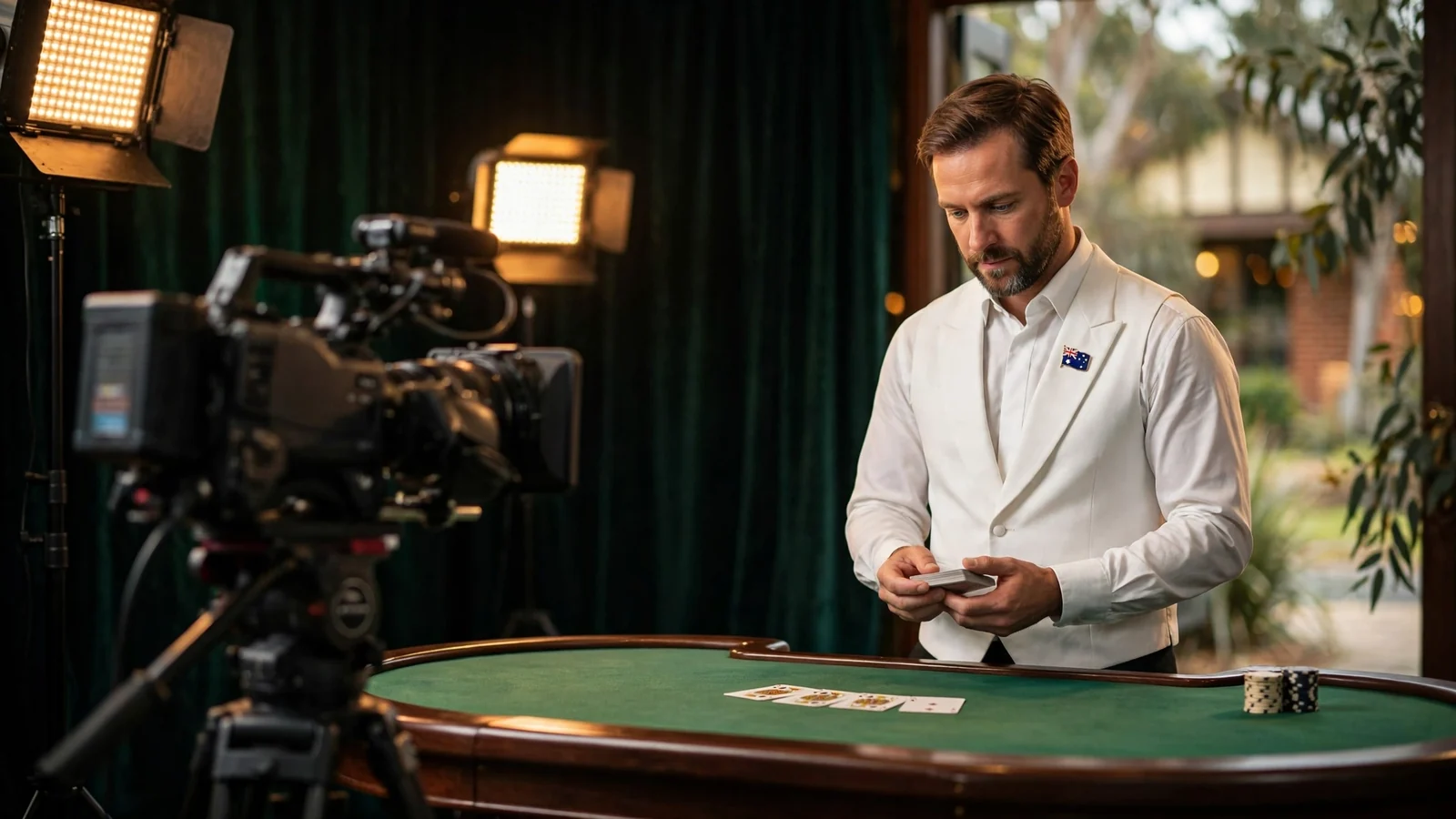
Table of Contents
- Live Casino in Australia: The Screen, the Dealer and the Legal Catch
- Live Casino Software: What the Provider Actually Controls
- Providers, Poker and the Machinery Behind a Live Table
- Live Casino Games: From Familiar Tables to Online Variations
- Live Roulette Online: Why the Wheel Still Holds the Room
- Live Dealers: The Human Interface Casinos Cannot Automate Away
- Live Casino USA: A Market Label, Not an Australian Licence
- How to Play Live Casino Online When the Market Says No
- Live Casino Apps: Convenience, Download Claims and the Small Print
- Live Casino AU and UK: Reading the Two-Letter Difference
Live Casino in Australia: The Screen, the Dealer and the Legal Catch
A live casino places a table in front of a camera. The dealer appears on screen, cards or a wheel are handled in real time, and the punter interacts through a digital interface rather than sitting across the felt. It looks like a compromise between a casino floor and a video call: the ritual is physical, while the participation is remote.
That distinction explains much of the format’s appeal. A conventional online casino game can feel self-contained, with symbols, buttons and automated outcomes doing all the visible work. A live table supplies a person, a room and a sequence of actions that unfold in public view. The dealer announces what is happening; the camera preserves the ceremony. Even when the screen is small, the table insists on being a social object.
For Australians searching for live casino online options, however, the screen does not erase the legal setting around it. The fact that a service can be viewed from Australia does not make it an Australian gambling product, and the phrase “live casino Australia” is not evidence of local authorisation. A label is still only a label. Marketing has never been famous for its respect for constitutional boundaries.
This page brings together notable options for playing live casino online in Australia in 2026. Use the listed licensing, promotions, and deposit details to identify which operator best fits your preferences.
License: Curacao eGaming Licence · Min. deposit: A$10 Aussie Play is a Curacao eGaming-licensed operator with a minimum deposit of A$10. It may suit players looking for a low starting deposit.
License: Curacao eGaming Licence · Min. deposit: A$10 WinSpirit operates under a Curacao eGaming Licence and accepts deposits from A$10. Its key appeal is the accessible minimum deposit.
License: Curacao eGaming OGL/2023/174/0082 (Dama N.V.) · Bonus: up to A$10,000 + 500 free spins across 4 deposits · Min. deposit: A$15 LevelUp Casino holds Curacao OGL/2023/174/0082 through Dama N.V. Its offer includes up to A$10,000 and 500 free spins across four deposits, with a A$15 minimum deposit.
License: Curacao Gaming Control Board (TechSolutions Group N.V.) · Bonus: 100% up to A$250 + 100 free spins (1st deposit) Bizzo Casino is licensed by the Curacao Gaming Control Board through TechSolutions Group N.V. Its first-deposit promotion provides 100% up to A$250 plus 100 free spins.
License: Curacao · Bonus: up to A$10,000 multi-stage + 500 free spins · Min. deposit: A$20 (POLi) Lucky Dreams operates under a Curacao licence and offers a multi-stage bonus of up to A$10,000 with 500 free spins. The minimum deposit is A$20 when using POLi.
License: Curacao OGL/2024/1335/0780 · Bonus: up to A$1,000 + 150 free spins, wager-free · Min. deposit: EUR 20 Vegaz Casino holds Curacao OGL/2024/1335/0780. It stands out for a bonus of up to A$1,000 plus 150 free spins described as wager-free, with a EUR 20 minimum deposit.
License: Curacao Gaming Control Board OGL/2023/176/0095 (Hollycorn N.V.) · Bonus: 100% up to A$10,000 + 100 free spins GoldenCrown is licensed by the Curacao Gaming Control Board under OGL/2023/176/0095 through Hollycorn N.V. Its promotion offers 100% up to A$10,000 plus 100 free spins.
License: Curacao Gaming Control Board · Bonus: up to A$5,000 + 400 free spins JustCasino operates with a Curacao Gaming Control Board licence. Its headline promotion includes up to A$5,000 and 400 free spins.
License: Curacao · Bonus: 100% up to A$500 + 200 free spins, 10x wagering · Payout speed: crypto 30-60 minutes, fiat 1-5 days · Min. deposit: A$10 Wild Tokyo is Curacao-licensed and offers 100% up to A$500 plus 200 free spins with 10x wagering. It lists crypto payouts in 30–60 minutes and fiat payouts in 1–5 days, with a A$10 minimum deposit.
License: Curacao, operated by Dama N.V. · Bonus: 325% up to 5.25 BTC + 250 free spins across 4 deposits 7Bit Casino is Curacao-licensed and operated by Dama N.V. Its promotion offers 325% up to 5.25 BTC plus 250 free spins across four deposits.
What “live” means
“Live” describes the presentation and operation of the table. It generally means that a dealer, studio or physical table is shown through a stream, with events taking place as the session runs. The player sees more than a graphic representation: there is a visible setting, a host and an observable chain of actions.
That is different from an automated online casino game, where the interface presents the result without a person dealing on camera. It is also different from a land-based casino, where the participant occupies the same room as the table. Online live casino sits between those arrangements. The room exists, but the player is elsewhere. The dealer is present, but only through the screen.
This matters because the format borrows the authority of physical gambling. A real table appears more tangible than a set of animated symbols. The dealer’s gestures give the session a pace; the camera gives it a location. Neither feature changes the legal character of the service when the underlying product is an online casino game offered to an Australian customer.
Live tables are not online pokies
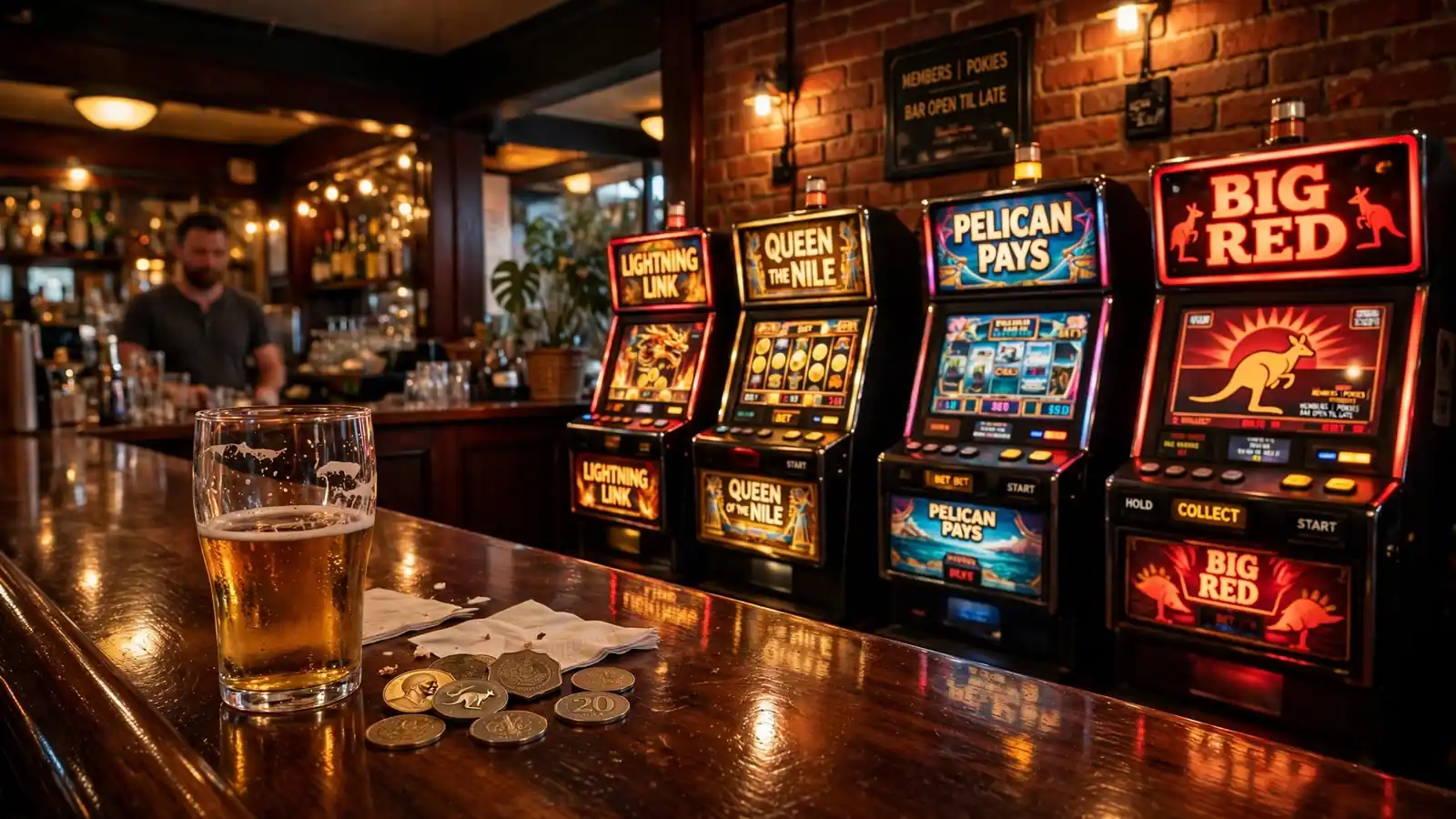
The Australian vocabulary makes this distinction especially important. “Pokies” is the familiar local term for gaming machines, particularly in pubs, clubs and land-based casinos. Online pokies are digital versions of that machine-based experience. Live dealer tables belong to another presentation category: they use a streamed human dealer and a physical table rather than reels and a machine-style interface.
The difference is therefore about format, not a loophole. Online pokies and live dealer tables are both online casino products when offered for real money. Changing the screen from spinning reels to a person dealing cards does not move the service into the permitted category of wagering. Nor does adding a studio, a chat panel or a more elaborate broadcast make the product locally licensed.
That is the legal catch hidden behind the attractive vocabulary. “Online live casino”, “live online casino” and “casino online live” may describe the same broad experience in different word orders, but none of those phrases creates an Australian licence. There is no Australian licence for online pokies, and none has ever existed. The same absence applies to a domestically licensed real-money online casino offering live tables to Australian players.
The Interactive Gambling Act
The main federal law governing online gambling in Australia is the Interactive Gambling Act 2001. Under it, online casino games, including pokies, are prohibited from being offered to people in Australia. Live dealer tables fall within that online casino context when an operator offers them as real-money casino play to an Australian customer.
The rule is directed at the service provider. Australian players are not prosecuted under the Act; enforcement targets the provider offering the prohibited service. That distinction is easy to lose in promotional language, where a page may speak warmly of access while leaving the legal responsibility in a fog. The absence of prosecution for the player should not be mistaken for domestic approval of the operator.
Australia does permit other forms of online gambling. Pre-event sports and racing wagering, lotteries and keno are among the products that can be licensed for Australians. Online casino games are not placed in the same group. A betting service with a lawful Australian offering is therefore not automatically entitled to provide live blackjack, live roulette or any other casino table online. Different products, different permissions.
Legal Restriction Under the Interactive Gambling Act 2001, online casino games are prohibited from being offered to people in Australia.
The result is a market with a peculiar visual contradiction: an Australian can encounter pages describing the best live casino online Australia 2026, while Australian law does not provide a domestic casino licence for that product. The screen may be accessible; the service is not thereby authorised. Geography in a title is not a regulator’s seal.
Reading the screen clearly
A live table can be entertaining as a piece of broadcasting. It can also create a stronger impression of presence than an automated game, which is precisely why the legal and practical distinctions deserve to remain visible. The dealer is part of the presentation, not proof of fairness, licensing or consumer protection. A studio is a location, not a jurisdiction.
For that reason, “best live casino” should not be treated as a simple ranking of attractive tables for Australian residents. Before presentation, branding or convenience comes the question of whether the underlying online casino service may lawfully be offered to people in Australia. Here, the answer is constrained by the Interactive Gambling Act 2001.
The table may look close. The law is not.
Live Casino Software: What the Provider Actually Controls
Live casino software is often described as if it were a single product: a polished table, a stream, a few buttons and an account balance. In reality, it is a stack of systems deciding what appears on screen, how a bet is recorded, how results are communicated and what evidence remains when something goes wrong. The cloth and chips are theatrical. The software is the stage manager.
That distinction matters in Australia, where terminology can blur the border between a game’s technical quality and the legality of the service offering it. A software provider may supply the underlying technology without being the operator that accepts an Australian customer. A recognisable interface does not create an Australian licence, and the label “best live casino software” is not a regulatory category.
The provider’s technical layer
A live casino software provider usually controls the tools that connect a studio or game system with an operator’s website. These tools can include the game feed, account integration, betting interface, settlement logic, reporting functions and controls for responsible play. The operator chooses how the service is branded and presented; the provider supplies much of the machinery underneath.
This separation explains why two different live casino sites can feel remarkably similar. They may use the same technical supplier, the same interface components or the same standards for recording outcomes. Conversely, two sites can display the same type of table while differing in account controls, payment handling, customer support and disclosures. A bright screen proves very little. It proves that someone has purchased bright screens.
The provider’s job is therefore not simply to make a table look convincing. It must keep the displayed event, the accepted wager and the settled result aligned. Timing becomes part of the product. The system has to show when betting opens, when it closes, whether a wager was accepted and how the result was applied to the balance. If those stages are vague, even a handsome interface becomes a source of dispute.
Audits, randomness and what RTP means
Randomness is another area where technical language needs careful handling. Licensed Australian-facing platforms are required to use independently audited random number generators. An independent audit is not a decorative badge. It is an external examination of whether the relevant system behaves as intended, rather than a promise invented by the site’s marketing department.
That point is especially important when a platform presents digital game elements alongside live content. A random number generator may determine outcomes in electronic games, while a live table records a physical event through studio equipment and settlement software. These are not identical mechanisms. The software layer must still preserve the integrity of whichever result the game uses and communicate it accurately.
RTP Explained Return to Player (RTP) is a long-term theoretical average, not a guarantee or forecast for any specific individual session.
RTP, or Return to Player, is also easy to misuse. It is a long-term theoretical average, not a forecast for a particular session. It cannot tell anyone what will happen in the next sequence of results, nor does it turn a short run into a contract. A platform that places an RTP figure beside a game without explaining its limits is offering a number with the most important part removed.
The same principle applies to online pokies. Online pokies and slot machines use the same reels, RTP and volatility; the difference is primarily local terminology. Calling a product “pokies” rather than “slots” does not change its mathematical model, licensing position or consumer protection. Nor does an attractive live-casino interface improve the underlying odds of an electronic game.
Presentation is part of the engineering
Game presentation is often treated as decoration, but it also governs comprehension. A well-built interface makes the betting state visible, separates confirmed wagers from pending actions and records the result in a way that can be followed after the event. It should not rely on animation to conceal a status change. Confusion is not atmosphere.
The same discipline applies to accessibility and device performance. A platform may need to handle changing connections, different screen sizes and interruptions without silently losing the relationship between a submitted action and the account record. A responsible design does not punish a player for a momentary technical failure by making the state impossible to reconstruct.
Clear rules belong here as well. The software should show the applicable game information before play, identify relevant limits and make account activity intelligible. Responsible platform design is not merely a link placed in the footer. It includes deposit controls, self-exclusion pathways and session reminders where the service is lawfully able to offer them. These features do not make gambling harmless. They make the system less willing to pretend that time and money are abstract concepts.

What “best” can and cannot mean
There is no universal best live casino site merely because one provider has impressive graphics. Technical quality can be assessed through narrower questions: Is the result recorded consistently? Is the random component independently audited where applicable? Are RTP explanations accurate? Does the interface distinguish an accepted wager from an attempted one? Are responsible-play controls visible rather than buried?
A free live casino or live casino online free mode can demonstrate layout and navigation, but it does not reproduce every condition of real-money play. Practice access may omit deposits, withdrawals, identity checks, account limits and the pressure created by actual stakes. It is a preview of software, not evidence that the underlying service is suitable or lawfully available.
The phrase “live casino solution” also deserves suspicion. It may describe a complete business package, a streaming module or a set of application interfaces. Those are different things. A provider can deliver an elegant technical solution while leaving the operator responsible for customer treatment, legal compliance and the claims made on the site.
Search labels such as “live casino Singapore” illustrate the same problem. A geographic tag can describe an audience, language or marketing route; it does not establish Australian authorisation. Software travels easily. Regulation does not. That is the part no interface can automate away.
Providers, Poker and the Machinery Behind a Live Table
A live-casino provider is the intermediary most players never see. The studio supplies the cameras, tables, dealing equipment and operational staff; the operator supplies the website, account system, payments and customer relationship. Between those two sits the provider’s infrastructure, carrying a real table into a branded interface.
Supplies cameras, tables, dealing equipment, and operational staff.
Supplies the technical infrastructure, game data, and streaming services.
Supplies the website, account systems, payments, and customer relationship.
That division matters. A casino website may look like a single product, but its live section can be assembled from several specialist services. One company may run the studio, another may supply the platform, and the operator may add its own wallet, promotions and identity checks. The player sees one login. Behind it is a chain of contracts and technical connections.
What the provider supplies
The provider normally packages the live stream with the information needed to make a table usable: game state, available seats or betting areas, results, limits set by the operator, and messages exchanged between the interface and the studio system. It also supports the technical routines that keep a session synchronised when a table is busy.
A live casino platform can therefore be understood as more than a video feed. It is an operating layer joining:
- the studio and its table equipment;
- the provider’s game and data services;
- the operator’s account and cashier systems;
- the mobile and desktop interfaces used by players.
The operator decides how this material is presented under its own brand. It may select which tables appear, attach its own terms, and place the games inside an existing account area. The provider remains responsible for much of the machinery that makes the table recognisable as a live product rather than an ordinary prerecorded clip.
APIs and integration
A live casino API provider offers structured connections between the provider’s systems and the operator’s platform. These live casino API integrations can pass table data, session information and game events without requiring the operator to build every component from the ground up.
Integration is rarely glamorous. It is the work of making separate systems agree about a player’s balance, a table’s status and the outcome recorded at the end of a round. If the connection is poorly designed, the visible symptoms are familiar: a delayed display, a rejected session, or an account balance that needs correction. The polished table is only the front room. The plumbing decides whether the house feels orderly.
The same structure supports mobile live casino services. A phone interface may be smaller and simpler, but it still depends on the provider’s studio feed, data exchange and session controls. “Mobile” changes the window, not the underlying division of labour.

Where poker fits
Live casino poker belongs to this supply chain, although it can involve a more complicated relationship between table, rules and operator. Some formats place a dealer at the centre while players participate through a digital interface; others depend more heavily on player-versus-player participation, with the operator supplying the room and transaction layer.
For that reason, “poker” does not identify one technical product. The relevant questions concern who runs the table, who manages the player pool, and which part of the experience is delivered by the provider. A poker label on a live casino platform may describe a studio-led table, a networked room, or a branded presentation built over an external service.
Reading reviews as infrastructure clues
Live casino reviews often concentrate on visible matters—table choice, interface, mobile access and the live casino login process. Those details are useful, but they do not reveal the whole supply chain. A review can describe a smooth front end without establishing who operates the studio or how the integration is maintained.
Regulation adds another boundary. Where an Australian-facing platform is licensed for a permitted product, its random number generators must be independently audited; that obligation belongs to the licensed service, not to a decorative brand name. The Interactive Gambling Act targets providers of prohibited online casino services, not the individual player. Responsibility travels upward through the machinery. The screen merely makes it look personal.
Infrastructure Realities
- A casino website is often a combination of several specialist services.
- API providers connect the studio’s technical output to the operator’s platform.
- Mobile interfaces change the viewing window but not the underlying division of labour.
Live Casino Games: From Familiar Tables to Online Variations
Live casino games borrow their authority from the physical table. The felt, the chips, the framed camera angle and the sequence of play all suggest a familiar institution, even when the session is taking place through a browser. Online presentation changes the room, not the basic families of games. The catalogue still divides into table games, card games, game-show formats and, at the edges, products that resemble pokies more than a traditional casino table.
The main families
Roulette is built around a wheel, a ball and bets placed on numbers, colours or combinations. Its online version makes the wheel visible on screen and organises betting information beside it. The game remains recognisable because its central object remains physical.
Blackjack is a card game shaped by decisions as much as by chance. Players compare their hand with the dealer’s according to fixed rules, while the interface displays cards, available actions and the running state of the round. The screen makes the table more legible; it does not turn the game into a pokie.
Baccarat uses a compact card format with betting centred on the Player, Banker or a tie. Online layouts tend to simplify the table into clear betting areas, useful for a game whose physical version can appear more ceremonial than complicated.
Poker variants occupy a less uniform category. Some formats place the house in a dealer role, while others use structured rules and side bets rather than a conventional player-versus-player table. The word “poker” therefore describes a family resemblance, not one single online experience.
Live casino game shows move further from the traditional table. They combine a host-led presentation with wheels, cards, bonus rounds or prize-board mechanics. Their appeal lies partly in spectacle: the format is closer to a televised contest than to a quiet table in a club. It is casino theatre with brighter lighting.
What changes online
A land-based table gives players a shared physical space. Online live casino games replace that space with a stream, interface and set of controls. The result can show the dealer, wheel, cards or game equipment while placing the betting panel, balance and round history around the image.
That arrangement affects attention. At a physical table, the surrounding room supplies pauses, noise and social cues. Online, the interface supplies labels and prompts instead. A casino live game becomes more immediately readable, but also more compartmentalised: the player sees the part of the table the camera and software choose to show.
The same distinction matters when a product is described as a live casino slot game. A genuine live table format and a pokie are not interchangeable simply because both appear in a casino lobby. Pokies use reels and an independently determined spin outcome. Each spin is independent, and the previous result has no bearing on the next one. RTP is a long-term theoretical average, not a promise about an individual session.
Where pokies fit
Online pokies may allow bets ranging from a few cents to hundreds of dollars per spin, with different volatility profiles. High-volatility pokies tend to pay less frequently but in larger amounts; low-volatility pokies tend to pay more often in smaller amounts. Those are characteristics of the game’s mathematical design, not evidence that one session will follow a pattern.
“Free live casino games” can also be a misleading label. A free-play display may imitate the look of a live table without involving real stakes or reproducing the financial conditions of paid play. The visual resemblance is real. The experience is not identical.
The catalogue, then, has several rooms: traditional tables, card-led formats, theatrical shows and reel-based pokies. Online design brings them under one roof, but it does not erase the differences between them.
- Review the terms of any live casino bonus.
- Understand the difference between live tables and pokies.
- Do not assume a geographic label implies an Australian licence.
- Do not treat RTP as a predictor of upcoming results.
Live Roulette Online: Why the Wheel Still Holds the Room
Roulette has survived every change in gambling technology because its central image is difficult to improve: a wheel turning in full view, a ball circling the rim, and a short pause before the table acquires its next fact. Live roulette online preserves that sequence while moving the room onto a screen. The result is neither a conventional computer game nor a copy of a casino floor. It is a broadcast table with betting controls attached.
That distinction explains the appeal of a live roulette casino. The wheel is visible. The croupier is present. The outcome arrives through an observable physical process rather than an animation selected from a digital menu. For some punters, that small ceremony matters more than speed. A virtual roulette game compresses the experience into software; a live table leaves room for the wheel to be watched.
What the online table changes
A casino live roulette table separates the social scene from the mechanics of placing a bet. The dealer manages the wheel and announces the result, while the online interface displays the betting layout, available selections and the closing of the betting period. The player is therefore watching a live event and operating a control panel at the same time.
This arrangement makes the table more legible for newcomers, but it also alters the rhythm. On a physical floor, the eye moves between the croupier, the wheel and the people around the table. In an online casino live roulette room, those signals are framed by a camera and surrounded by interface elements. The screen decides what receives attention. A polished presentation can make the table feel intimate; a crowded one can reduce the wheel to decoration.
The visible wheel does not make the result predictable. Each spin is independent, and the previous result has no bearing on the next outcome. A run of colours may look suggestive because human attention is excellent at finding patterns, including patterns that have no predictive value. The wheel remains a mechanical spectacle, not a diary of what should happen next.
Reading claims without reading too much into them
Descriptions of the best live casino sites often emphasise studio quality, table limits, camera angles or live casino bonuses. Those details may affect the experience, but they do not turn a losing sequence into a favourable one. A bonus is a condition attached to an offer, not evidence that the underlying game is safer or more generous. Its terms deserve separate attention from the wheel itself.
The same restraint applies to RTP. Where a live roulette product publishes an RTP figure, RTP is a long-term theoretical average, not a promise about an individual session. It cannot explain what will happen during one visit, and it does not convert a previous result into a clue about the next one.
This is why online casino live roulette is best understood as a particular form of presentation: a dealer-led table, a physical wheel and a digital betting surface. The theatre is real enough. So is the uncertainty.
Live Dealers: The Human Interface Casinos Cannot Automate Away
A live casino dealer does more than move cards or announce a result. The dealer supplies the table with a human rhythm: a greeting, a pause before the action, a repeated explanation for someone joining mid-round. In a digital room otherwise made of menus, timers and account balances, that presence gives the session a social shape.
Live Dealer A real person conducts the game via a video stream, providing a physical ritual and human rhythm to the digital session.
This is why an online casino with live dealers feels different from an automated table. The camera shows a studio rather than a bare interface. There may be a branded backdrop, polished lighting, several tables running at once and a presenter trained to keep the pace even when the room is quiet. The performance is controlled, but it is still recognisably a performance. Casinos discovered long ago that atmosphere helps make repetition feel like occasion.
What the dealer actually adds
The dealer is the visible part of a larger arrangement, not the mechanism that decides outcomes. Cards, wheels and other table equipment remain subject to the platform’s underlying controls, while the dealer handles the public ritual around them. That distinction matters. A confident host can make a table easier to follow, but charm is not evidence of favourable odds, fairer treatment or legal availability.
At a casino with live dealers, interaction usually takes place through a limited set of tools: chat, game controls and table selections. The dealer may acknowledge a message or explain a procedure, but this is not a private conversation. It is a broadcast shared with a room of strangers, complete with the quiet social pressure of being seen while money is at stake.
Live dealer blackjack illustrates the division neatly. The dealer deals, speaks and settles the hand on camera; the software records choices, displays the table and passes instructions between the participant and the studio. The person creates continuity. The system creates access. Neither role should be mistaken for the other.
Studio polish and social theatre
The studio also manages attention. A dealer’s posture, timing and language tell viewers when a round is open, when decisions have closed and when the table is moving on. Multiple camera angles can make a small set appear expansive. A clean feed can suggest reliability, although presentation quality remains a presentation quality.
The same applies to live casino dragon tiger and other dealer-led formats. Their attraction is not only the rules. It is the feeling of entering a room already in progress, where an identifiable person conducts a ceremony rather than an icon simply changing state. That feeling can be pleasant, but it can also encourage longer sessions by making each round feel socially connected to the next.
The human layer is not a licence
A live casino for real money may display professional dealers, detailed rules and polished responsible-gambling notices while offering no Australian casino licence. The existence of a person on screen changes the experience, not the legal category. Under the Interactive Gambling Act 2001, enforcement targets the provider; Australian players are not prosecuted merely for participating.
Nor does a dealer replace technical oversight. Where an Australian-facing platform is licensed for a permitted gambling product, independently audited random number generators are required. That audit concerns the relevant system, not the dealer’s personality.
The human interface is persuasive. It is not proof.
Live Casino USA: A Market Label, Not an Australian Licence
“USA” in a live-casino label is often a signpost, not a legal address. It may indicate that a platform carries American tables, presents prices in US dollars, uses English-language branding, or wants to resemble a service designed for players across the Pacific. None of that turns an overseas website into an Australian gambling service.
The same caution applies to phrases such as live online casino USA and online live casino USA. They describe a commercial audience or catalogue more readily than they establish where the operator is authorised. A table showing a dealer on screen remains an online casino product, whatever flag appears beside the logo.
Australia’s central rule is found in the Interactive Gambling Act 2001, the main law governing online gambling in the country. Real-money online casinos offering pokies to Australians are banned under that Act. The prohibition is not softened by a platform’s use of live dealers, a foreign market label, or a polished Australian-facing homepage. There is no Australian licence for online pokies, and none has ever existed. The same absence matters when the product is a live table rather than a reel-based game.
Market Labels Attention A geographic tag like “USA” or “UK” describes a marketing target and does not establish Australian authorisation.
That makes “Australian live casino” an especially slippery phrase. It can mean a site that accepts Australian visitors, displays Australian currency, or publishes localised information. It cannot, by itself, mean an Australian-authorised casino. A foreign licence may describe the operator’s position in another jurisdiction; it does not become an Australian licence by appearing in the footer.
Bonus language creates a second layer of confusion. A live casino bonus may be advertised as a welcome offer, a deposit match, or a promotion attached to selected tables. Those conditions concern the marketing arrangement: wagering requirements, eligible games, expiry rules, and withdrawal restrictions. They do not alter the legal status of the service providing the tables. A bonus is not a permit wearing brighter colours.
The sensible distinction is therefore plain:
- Market label: who the operator says the service is for.
- Bonus label: what promotional terms are attached to an account.
- Australian authorisation: a domestic casino licence, which does not exist for online pokies.
The first two can appear together on a page. They cannot manufacture the third.
How to Play Live Casino Online When the Market Says No
The phrase “play live casino online” sounds straightforward: open a table, watch a dealer, place a wager. In Australia, the legal position makes that apparent simplicity misleading. Online casino games, including live dealer tables, are prohibited from being offered to people in Australia under the Interactive Gambling Act 2001. The law is directed at providers, not individual punters. Australians are not prosecuted merely for placing bets with an offshore service.
That distinction explains why international platforms remain visible. An offshore casino based in Curaçao, Anjouan or a similar jurisdiction may accept Australian players, even though Australia has no domestic licence for real-money online casino games. Acceptance is not approval. A foreign registration does not turn a prohibited product into an Australian-licensed one.
What overseas labels really mean
Country names attached to live-casino pages are often descriptions of audience, language or payment targeting rather than evidence of local authorisation.
A Malaysia-focused live casino may be designed for Malaysian players, display local currency or use regional support. None of those features establishes permission to serve Australians. The same applies to services marketed around Canada or India. Their jurisdictional language belongs to the operator’s commercial positioning, not to Australian gambling law.
Geography is not a safety certificate. A studio may be located in one country, its software supplied from another and its operator registered elsewhere. The screen gives the arrangement a single, polished face. The legal structure underneath is less theatrical.
Playing abroad is not the same as being protected at home
Offshore access creates a narrow but important distinction. Australian residents can legally play online pokies at licensed offshore casinos, while the provider may still be acting outside the Australian legal framework when offering prohibited online casino services. The player’s position and the operator’s position are not identical.
That does not make every overseas casino reliable, fair or suitable. An offshore licence is not an Australian casino licence, because no such Australian casino licence exists. It may also leave dispute handling, identity checks, withdrawals and responsible-gambling measures subject to foreign rules.
The practical meaning is therefore plain: “live casino Malaysia”, “live casino Canada” and “live casino India” describe international routes into the product, not Australian permission. The market says no to domestic online casino provision. Foreign websites may still say yes. Those two statements can coexist.
Is there an Australian licence for online pokies?
No, there is no Australian licence for online pokies, and none has ever existed.
Are offshore casinos legal for Australians?
While Australian law prohibits providers from offering services, offshore casinos may still accept Australian players despite the lack of domestic approval.
Live Casino Apps: Convenience, Download Claims and the Small Print
A live casino app is often presented as a shortcut: tap an icon, enter a table, and let the screen imitate a casino floor. The practical difference between an app and a mobile website may be much smaller. Some “apps” are little more than packaged web pages, while others use a dedicated interface for account access, streaming and payments. The icon is not evidence of substance. It is branding with a download button.
That matters in Australia, where a polished interface cannot create a domestic casino licence. Online casino games, including live dealer tables, are prohibited from being offered to Australian customers. An app may be technically available, but technical availability is not authorisation, and a familiar Australian payment label does not supply consumer protection that the product itself does not possess.
Download claims and device permissions
A live casino app download deserves the same scrutiny as the service behind it. The small print should identify the operating company, its governing jurisdiction, account-verification rules and the handling of withdrawals. Vague references to “global licensing” are not a substitute for a clearly identified licence, and an offshore licence is not an Australian casino licence.
Device permissions are another quiet part of the bargain. A live-table application may request access to notifications, storage or biometric features. Only some of those permissions are necessary for the stated function. An installation file obtained outside an official app store also creates a separate security question: the source of the file becomes part of the risk assessment.
Payment language can be equally slippery. Since 11 June 2024, a single profile source reports that credit cards, credit-related products and cryptocurrency are banned as payment methods for online wagering in Australia. PayID itself does not charge players a transaction fee, but that fact says nothing about whether a particular casino service is lawful or reliable. A free transfer is still attached to the service receiving it.
What “API” actually tells anyone
A live casino API is a technical connection between systems. It may carry game data, account instructions or streaming functions between an operator’s interface and an external platform. The phrase sounds authoritative because programmers use it; it does not prove that the operator is licensed, that its games are independently audited, or that a withdrawal will be honoured.
The same caution applies to lists of “top live casino websites”. A prominent position, a glossy app and a fast-loading table measure presentation. They do not establish legality, fairness or redress. A serious comparison therefore starts with ownership, jurisdiction and terms—not the size of the download button.
Small print first. Always.
Live Casino AU and UK: Reading the Two-Letter Difference
“AU” and “UK” look like tidy geographic labels. On a casino page, however, they can be little more than signposts for language, currency, marketing or intended traffic. The two letters are not interchangeable guarantees of legality, consumer protection or local authorisation.
A live casino aimed at the UK market sits within a different regulatory structure from one presented to Australians. That difference matters more than the familiarity of the interface. An English-language table, Australian dollars in a dropdown or a page carrying “AU” does not create an Australian casino licence. There is no such licence for online casino games offered to Australian residents.
The legal dividing line is set by Australia’s Interactive Gambling Act 2001, the main federal law governing online gambling. Real-money online casinos offering pokies to Australians are banned under that Act. The restriction covers the broader online-casino category, not merely one preferred spelling of a product. Calling a service “live casino AU” changes its label, not its legal character.
The UK wording carries its own context. “Live casino UK” may describe a service designed for British customers, while “online live casino UK” may simply be a commercial description of the same intended market. Neither phrase says anything reliable about whether the service may legally accept an Australian customer.
This is where two letters become an oddly efficient disguise. A page can borrow the vocabulary of one jurisdiction while being accessed from another, leaving the visitor to supply the missing assumptions. A location tag is not a licence, and a familiar national abbreviation is not a regulator.
For an Australian reader, the decisive frame remains Australian law, not the country printed in a banner. The label may identify a market. It cannot rewrite the Act.
Written by the editors at Betting Top 10 Australia.