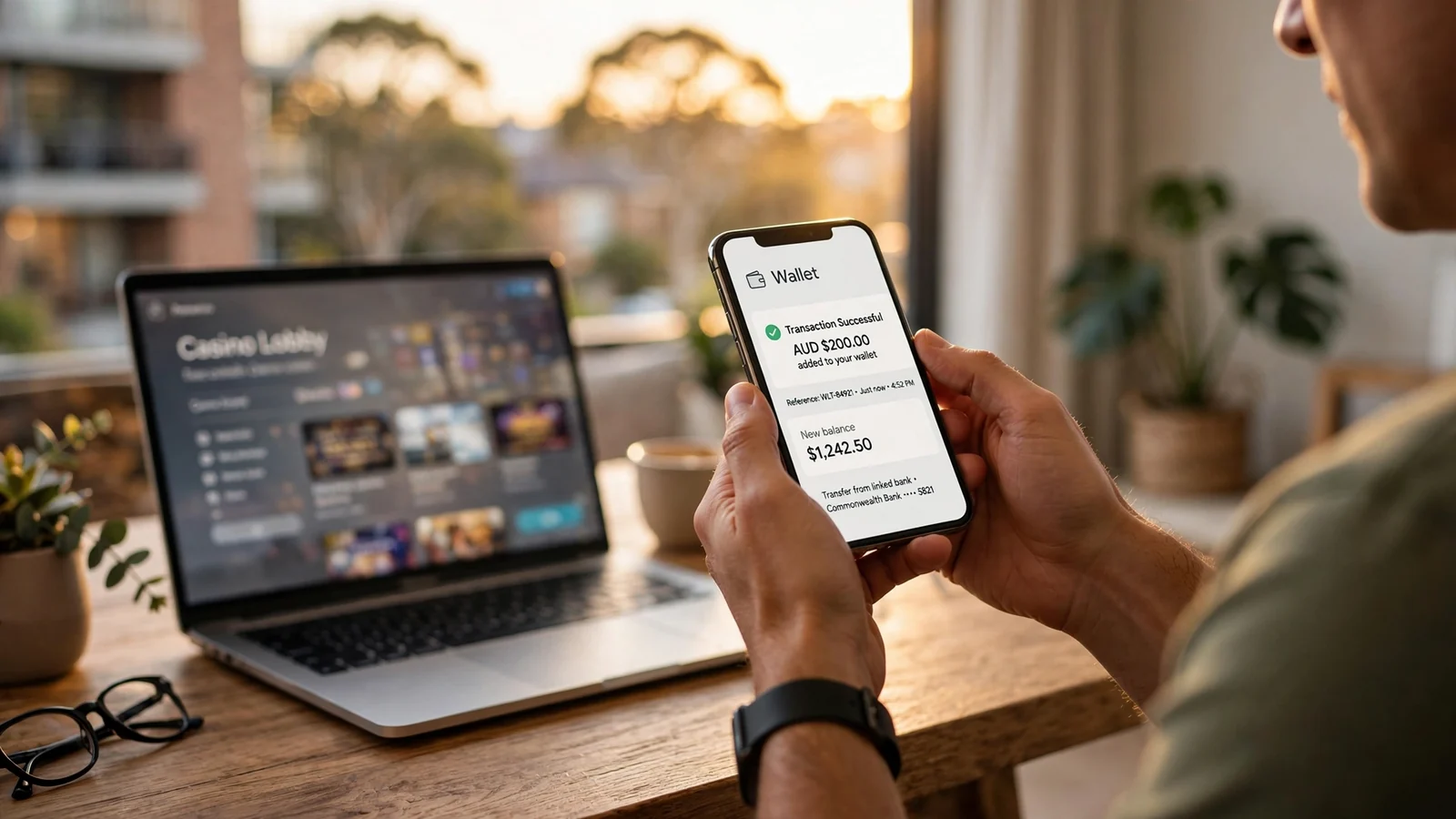

New PayID Pokies Australia: Payments and Safety
 Available in US
Understand the payment process, practical limits and legal distinction between PayID infrastructure and online pokies.

What Makes New PayID Pokies Different in 2026
The phrase new PayID pokies Australia 2026 sounds as if it describes a fresh type of slot machine. It does not. The “new” part usually belongs to the casino listing, the payment option, or the way an operator presents its cashier. PayID itself is neither a game nor a casino feature. It is a payment addressing service connected with Australia’s New Payments Platform.
That distinction matters because gambling language has a talent for turning infrastructure into entertainment. A payment rail becomes a “pokies method”; a bank identifier becomes part of a casino brand. The result is memorable, but technically untidy. PayID pokies are simply pokies offered by a site that accepts PayID as a way to move money.
PayID is an address, not an account
PayID was developed as part of the New Payments Platform in February 2018. Its purpose was to make bank transfers easier to address. Instead of asking for a traditional combination of bank details, a payment can be directed to an identifier linked to the recipient’s account.
That identifier may be:
- a mobile number;
- an email address; or
- an Australian Business Number.
The identifier is connected to a bank account behind the scenes. It is not the bank account itself, and it does not create a separate balance. The money still moves between Australian bank accounts. PayID simply changes the information used to find the destination.
This is the central difference between new PayID pokies and older descriptions of casino banking. The payment method is built around an address that is easier to recognise than a BSB and account number. The casino does not receive those traditional bank details merely because a PayID transfer has been made. The PayID identifier points to the account, while the BSB and account number remain undisclosed to the casino.
A small change in language, then, produces a meaningful change in handling. Bank details are dense, easy to transpose and difficult to identify at a glance. A registered mobile number or business identifier is more legible. That does not make the destination automatically trustworthy. It makes the destination easier to address.
Why the term “new PayID pokies” has appeared
Casino payment categories are often named after the route used to fund them. Card pokies, bank-transfer pokies and crypto pokies follow the same pattern: the game does not change, but the cashier supports a different payment instrument. New PayID pokies belong to that same commercial vocabulary.
The label can refer to several modest developments:
- a newly listed casino that accepts PayID;
- an existing casino adding PayID to its cashier;
- a redesigned payment page that gives PayID greater prominence; or
- a new collection of pokies advertised alongside the payment option.
None of these turns PayID into a gambling product. A slot remains a slot. Its reels, symbols and rules are separate from the method used to place funds in a casino account. The payment address does not alter the game’s identity, and a new cashier button does not create a new form of gambling.
That separation is useful when comparing PayID pokies new to other casino terminology. A title may be new to a particular site while PayID itself is not new. The service has been part of the Australian payments landscape since 2018. What changes is the operator’s decision to support it and the way the option is presented.
The Australian character of the system
PayID is especially recognisable in Australia because it was created within the country’s own payments infrastructure. It is not an imported casino wallet wearing a local label. Nor is it a private balance held by a gambling company. The underlying movement of funds remains a bank-to-bank transfer through the New Payments Platform.
This explains why a PayID casino deposit is described in banking terms rather than wallet terms. There is no need to open a separate PayID account and no independent PayID balance waiting to be spent. The identifier is attached to an existing bank account. In practical language, PayID tells the bank where to send the money.
The arrangement also reflects a broader Australian habit: keeping everyday payments close to the banking system. The mobile number, email address or Australian Business Number becomes a readable front door, while the less visible account details remain in the banking system. The innovation is not theatrical. It is administrative. That is precisely why it has travelled well into commercial settings.
The casino industry gives this ordinary banking tool a more dramatic name. The infrastructure remains ordinary.
Legal Status PayID access does not grant a casino a licence to operate in Australia. No domestic licence exists for offering online casino games to Australian customers.
What a PayID-enabled casino can and cannot claim
A casino that displays PayID is showing that it has connected its cashier to a payment route supported by the service. It is not demonstrating that the casino is approved, safe, locally licensed or entitled to offer online casino games to Australians. Payment access and gambling status are different questions.
This is particularly important in Australia. The Interactive Gambling Act 2001 makes it illegal for gambling providers to offer some online services to people in Australia, and online casino games such as pokies are prohibited interactive gambling services when offered to an Australian customer. No Australian gambling licence exists for casino games because offering that product to Australians is against the law.
The payment method cannot soften that legal distinction. A bank-linked address does not become a licence by appearing in a cashier. A familiar banking process can make a commercial page look established, but appearance is not authorisation. The system was designed to move payments, not to certify the business receiving them.
That is why the expression new PayID pokies Australia should be read descriptively, not as a legal category. It identifies a combination of casino content and payment support. It does not establish that the operator has an Australian casino licence, because no such domestic licence exists.
Why the identifier still deserves attention
Although PayID is not a gambling product, the identifier shown during a payment remains an important part of the transaction. It represents the bank account receiving the money. The difference between a registered business identity and an unexplained personal name is not cosmetic.


The same caution applies to the information requested by a casino. PayID is meant to reduce the need to disclose traditional bank details, not to remove the need for scrutiny. A payment address should correspond to the intended recipient, and a casino’s legal identity should be clear before money is sent. A temporary or alternative PayID destination requested by an operator is not made legitimate by the PayID logo.
This is where the apparent simplicity of the service can mislead. A mobile number feels familiar. An email address feels harmless. An Australian Business Number sounds official. Yet each is only an address linked to a bank account. The identifier tells the bank where the payment is directed; it does not explain why that recipient should receive it.
A clean interface is not evidence. A recognisable payment method is not evidence. The name behind the address matters.
What is genuinely different in 2026
The newer character of PayID pokies in 2026 lies mainly in market presentation. More casino pages treat PayID as a headline feature, and the phrase has become a compact way to describe a casino payment environment. But the underlying concept remains stable:
- PayID is part of the New Payments Platform.
- It uses a mobile number, email address or Australian Business Number linked to a bank account.
- The transfer moves between Australian bank accounts.
- The casino does not receive the payer’s BSB and account number through the identifier.
- PayID is not a wallet, slot type or gambling licence.
That list is less glamorous than “new pokies”, but it is more accurate. The service changes how a payment is addressed, not what the game is. The casino may be newly listed, newly integrated or newly branded around PayID; the payment architecture itself is a bank-linked addressing service.
The useful boundary is therefore simple: PayID describes the route, while pokies describes the gambling content. Confusing the two makes the casino sound more official than the payment system can ever make it. A bank transfer remains a bank transfer, even when the cashier gives it a fashionable name.
New PayID Online Pokies: From Bank Transfer to Spin
The practical appeal of PayID online pokies is not found in the slot cabinet. It appears in the cashier, at the small moment when a deposit stops being a bank transfer in theory and becomes credit on a gaming account. The route is short, but it has a few deliberate turns: select PayID, read the payment instructions, copy the operator’s reference code, approve the transfer in the banking app, and wait for the casino to post the funds.
Deposit Process
Select PayID within the online pokies cashier to view the operator’s specific instructions.
Note the registered PayID identifier and the unique reference code provided.
Open your banking app separately, enter the PayID and exact reference code, then authorise the transfer.
That sequence matters because PayID is not a button that somehow carries money by itself. It is the addressing layer used to direct a bank payment to the operator. The casino still needs to identify the account behind the payment. Hence the reference field, the recipient name, and the occasional pause while the cashier catches up with the banking network.
Starting in the cashier
A deposit begins inside the online pokies cashier, not in the banking app. The cashier should display PayID as an available payment option. Selecting it normally opens the operator’s payment instructions, which may show the registered PayID identifier, the recipient name, and a unique reference code connected with the player’s casino account.
This order is important. Opening a banking app first and sending money to an address found elsewhere removes the cashier from the process. It also makes the payment harder for the operator to match. A PayID transfer may be correctly delivered to a bank account and still remain uncredited to the intended casino balance if the operator cannot connect it with the right player record.
The cashier therefore acts as the bridge between the account and the payment. It tells the bank where the funds should go and tells the operator how to recognise them when they arrive. The process is less mysterious than the marketing language suggests. It is a bank transfer with a casino-side filing system attached.
Before approving the payment, the recipient details displayed in the cashier should correspond with the registered business entity of the operator. The payment should be approved only within the player’s own banking app. A request to confirm a transfer through an unfamiliar page, message, or improvised payment screen is not part of the normal PayID route.
The reference code is the hinge
The unique reference code is the detail most likely to look administrative and prove decisive. It allows the casino to match the incoming PayID payment with the correct player account. Without it, the transfer may arrive at the operator’s bank account while the casino balance remains unchanged.
Reference Importance The unique reference code is the essential link that allows the casino to match your PayID payment to your specific player account.
The code should be copied exactly as shown in the cashier. It is not a promotional code, a bonus phrase, or a personal note. Its job is narrower and more useful: it labels the payment for the operator’s reconciliation process. A wrong character can turn a nearly immediate deposit into a support query.
The same principle applies when the banking app asks for a description or reference. That field is where the cashier’s code belongs. The recipient identifier directs the payment; the reference code explains which casino account should receive the credit. Two separate pieces of information, each with an unglamorous job.
A careful sequence looks like this:
- Open the casino cashier and choose PayID.
- Read the displayed recipient details and unique reference code.
- Open the banking app separately.
- Enter the PayID identifier and the exact reference code.
- Check the recipient name before approving the payment.
- Authorise the transfer inside the banking app.
- Return to the casino cashier and wait for the deposit status to update.
There is no advantage in rushing the final check. The payment itself may be fast; correcting a payment sent with the wrong recipient or reference is a different, slower matter.
What happens after approval
PayID transfers operate through Australia’s New Payments Platform and are described as near real time. They are available around the clock, including weekends and public holidays. That makes the bank-side movement notably less tied to office hours than older transfer arrangements.
The casino side has its own clock, however. PayID casino deposits usually reach the casino within seconds, although posting the funds to the gaming account can take a few minutes. The distinction is easy to miss because the banking app may show a completed transfer before the casino balance changes. Nothing contradictory is happening. The bank has confirmed movement of the funds; the operator still has to receive, identify, and post the payment.
A short delay is therefore not automatically a failed deposit. The cashier may be waiting for the payment notification, matching the reference code, or refreshing the account balance. The useful evidence is the combination of the bank confirmation and the casino’s deposit status, not one screen viewed in isolation.
If the balance remains unchanged after the relevant wait, the first checks are mechanical:
- confirm that the transfer was approved in the banking app;
- compare the reference code used with the one shown in the cashier;
- check that the recipient details matched the operator’s displayed business identity;
- review whether the casino marked the deposit as pending, received, or unsuccessful;
- retain the banking confirmation for any support request.
These checks are more productive than sending a second payment immediately. A duplicate transfer can create a second reconciliation problem while the first one is still being processed. Casinos are many things, but clairvoyant is not one of them.
From balance to spin
Once the operator posts the funds, the deposit becomes part of the casino balance and can be used in the online pokies lobby. The visible transition is simple: the pending or empty balance changes, the cashier records the deposit, and the slot interface becomes available for play according to the operator’s account conditions.
The payment method does not alter the underlying game. PayID supplies the route by which funds enter the account; it does not turn a particular title into a special PayID version. A new title in the lobby remains a slot, whether the balance was funded through PayID or another available method. The distinction belongs to the cashier, not the reels.
This is why the operational details deserve more attention than the word “instant”. Speed is useful only when the payment reaches the intended business account, carries the correct reference, and appears in the correct casino account. A transfer that moves quickly to the wrong destination is merely a faster mistake.
The same practical logic applies across new PayID pokies online: start with the operator’s cashier, use only the instructions generated there, and let the banking app perform the actual approval. The bank handles the transfer. The reference code handles recognition. The casino handles posting. Keeping those roles separate makes the journey from bank account to spin far less theatrical—and considerably easier to diagnose when a few minutes become more than a few.
Pay ID Pokies Payments, Limits and Withdrawals
The attractive part of PayID is the disappearance of ordinary banking friction. The less attractive part begins when money has to move in the other direction. A deposit can appear in a casino balance with little ceremony; a withdrawal has to survive the casino’s internal checks first. That difference explains why new PayID pokies can feel immediate on the way in and distinctly less so on the way out.
- Check your bank’s daily PayID transfer limits.
- Verify the recipient name matches the operator’s business entity.
- Use the exact reference code provided in the cashier.
- Assume the casino controls your bank’s transfer ceilings.
- Use an improvised or alternative PayID requested outside the cashier.
- Send a second payment before the first one is fully processed.
PayID itself is not the party charging for the transfer. It is a payment addressing service operating through Australia’s New Payments Platform, and the NPP does not charge end users for real-money transfers made through PayID. If a casino adds a fee, that fee belongs to the operator’s own transaction policy. The payment rail is not quietly collecting a casino toll.
Who controls the limits?
The limit question has two separate answers, because two different businesses are involved.
The bank controls the daily and weekly PayID transfer limits on the account. Australian banks, including Commonwealth Bank, ANZ, Westpac and NAB, support PayID real-time transfers, although support for the payment method does not erase the bank’s own risk controls or account settings. A specialist overview reports that more than 110 banks and credit unions participate in the NPP and support PayID, but participation in the network is not a promise that every gambling-related transaction will be treated identically.
The casino controls its own cashier rules. That includes the minimum amount accepted for a transaction, the available withdrawal methods and any operator-imposed fee structure. A specialist overview attributes the per-transaction minimum to the casino and the daily transfer ceiling to the bank. Those are different limits, and confusing them creates the familiar spectacle of blaming a casino for a banking cap or a bank for a cashier rule.

A payment can therefore fail for reasons that have nothing to do with the PayID address itself. The bank may reject or hold a transfer because the account limit has been reached. The casino may refuse an amount below its stated minimum. The operator may also display a withdrawal option without making every amount or every account eligible for it. The cashier is a menu, not a constitutional document.
Bank settings deserve attention before a substantial real-money transfer. Australian bank Osko sending limits are typically described as falling between A$1,000 and A$30,000 per day in a specialist payment overview, while another specialist overview lists default daily PayID limits at major banks ranging from A$750 to A$5,000. These figures come from different source descriptions and should not be treated as a single market-wide rule. Commonwealth Bank is described in a specialist banking overview as applying a default daily PayID cap of AU$1,000 for new payees, with the possibility of raising it through the app.
The practical point is simpler than the figures: a casino cannot raise a bank’s PayID ceiling. A bank cannot rewrite the casino’s minimum withdrawal. Before planning a large deposit or cash-out, the relevant NPP limit belongs to the bank account, while the relevant cashier minimum belongs to the operator.
Fees: payment method or casino policy?
The distinction matters because “free PayID” can be understood too broadly.
PayID itself is free for Australian players. That means the payment system does not impose an end-user charge merely because a transfer uses a mobile number, email address or another PayID identifier. It does not mean every casino promises free movement of funds.
Transaction Fees Attention PayID itself is free, but the casino operator may apply its own fees to deposits or withdrawals according to their policy.
Any fee encountered in a PayID casino cashier is set by the operator rather than the payment system. The fee might be attached to a particular transaction, a withdrawal route or an account policy. Its existence, amount and conditions must therefore be read in the casino’s own terms and cashier information. A bank statement showing a charge would not automatically prove that PayID created it; the operator’s rules remain the relevant place to identify a casino fee.
This is one reason the advertised payment method should not be mistaken for the complete financial arrangement. The same PayID infrastructure can sit beneath different operator policies. One casino may present the route without a separate charge, while another may attach its own condition. PayID supplies the address. The casino writes the small print.
Why withdrawals take longer
PayID casino withdrawals typically arrive within two to 12 hours, because the delay occurs on the casino side before the payment is released. The bank transfer itself may be designed for near-real-time movement, but the casino first decides whether the withdrawal can leave its system.

That review can include several checks:
- wagering-requirement checks;
- KYC verification;
- anti-money-laundering checks;
- confirmation that the balance represents available real funds;
- review of suspicious activity;
- batched payout schedules.
The result is an asymmetrical experience. A deposit can be credited within seconds, although casino posting can take a few minutes. A withdrawal has to pass through an administrative corridor before PayID becomes relevant again. The payment address is fast; the institution standing behind the cashier is not obliged to be.
KYC is particularly important at the withdrawal stage. A casino may request identity information before releasing funds, even where the deposit appeared without a comparable interruption. The name on the PayID bank account should match the name on the casino account and identity documents. A mismatch can turn a routine request into a verification case, because the operator has to establish who owns the account and who is entitled to receive the funds.
The same logic applies to wagering conditions. A displayed casino balance is not necessarily identical to an amount immediately available for withdrawal. Pending requirements, incomplete verification or a review of the source and use of funds can delay release. The balance may be visible while the payout remains backstage.
Then there is batching. Some casinos do not process every approved withdrawal as an individual event at the instant it is requested. Batched schedules gather approved payments for later release, adding an operational pause that has nothing to do with a faulty PayID identifier. The system is not broken. It is queueing.
Bank support is not blanket permission
The major Australian banks support PayID real-time transfers, and PayID transfers to and from real-money gambling sites are not blocked by Australian banks by default. That statement should not be stretched into a guarantee that every transaction will pass without scrutiny.
A specialist banking overview reports that some banks offer opt-in gambling blocks, while others may flag unusual gambling-related activity for review. A bank can therefore support PayID as a payment function while applying separate controls to the recipient, transaction pattern or account behaviour. Technical compatibility and institutional permission are related, not identical.
This distinction also explains why a failed transfer should not immediately be interpreted as proof that the casino has disappeared or that PayID has stopped working. The bank may have applied a limit, a block or a review. The casino may have supplied an unsuitable recipient, imposed a minimum or paused the account for verification. Several doors lead to the same corridor, and any one of them can close.
Banking vs Casino
- The bank governs transfer limits and PayID functionality.
- The casino governs minimum amounts and withdrawal rules.
- Technical compatibility with PayID does not equal legal authorisation to gamble.
The responsible check is narrow and unglamorous: confirm the bank’s current PayID and NPP settings before arranging a large real-money payment, and read the casino’s cashier terms separately. The bank governs the transfer ceiling. The operator governs its cashier conditions. Neither governs the other.
A withdrawal checklist without theatre
Before requesting money back to a bank account, the essential conditions are administrative rather than glamorous:
- Complete KYC verification before the first withdrawal.
- Confirm that the PayID name on the bank account matches the casino account and identity documents.
- Check whether the casino supports PayID withdrawals, rather than merely accepting PayID deposits.
- Review the casino’s withdrawal conditions, including any wagering requirements and operator-set fees.
- Make sure the requested amount is available real money, not a balance subject to a pending restriction.
- Keep the bank’s daily or weekly PayID limit in mind.
- Treat an unexpected delay as a reason to check verification, limits and payout scheduling before assuming a payment-system failure.
The final distinction is the one most easily lost in promotional language. PayID can make the transfer route quick. It cannot make a casino’s compliance department disappear, cannot override a bank’s limit and cannot turn an operator’s fee into a payment-system charge. New pokies with PayID are still subject to old institutional habits: limits, forms, checks and the occasional queue.
New PayID Pokies Australia for Real Money: The Legal and Safety Line
PayID can make a bank transfer feel deceptively ordinary. A mobile number or email address is entered in a banking app, the payment is approved, and the money moves through the New Payments Platform. Nothing in that sequence turns an online slot site into a lawful Australian casino.
That distinction is the essential line. PayID is a payment address, not a gambling licence. A bank may process a transfer because its payment system recognises the destination; that does not amount to approval of the operator’s business or its games.
Payment access is not gambling permission
The Interactive Gambling Act 2001 makes it illegal for an operator to offer real-money online casino games to Australians from within Australia. Online pokies fall within that category. Australia has no domestically licensed real-money online casino for Australian players, and no Australian gambling licence exists for casino games because offering that product to Australians is against the law.
The law targets the provider rather than the individual player. Australian law does not make it illegal for a private individual to place bets at an offshore online casino. That is a narrower statement than an endorsement. Offshore play still carries legal and financial risks, and a payment method cannot remove them.

The banking picture adds another layer of confusion. Commonwealth Bank, ANZ, NAB and Westpac support full PayID functionality. ANZ, CommBank, NAB and Westpac also permit real-money PayID transfers to online casino accounts in AUD, subject to their standard transaction limits. Yet support for PayID does not necessarily mean that a bank permits PayID transfers to gambling operators in every circumstance.
A bank’s payment infrastructure is not a moral certificate. That would be a remarkably convenient job for a banking app.
PayID transfers to and from real-money gambling sites are not blocked by Australian banks by default. A specialist industry overview reports that some banks have introduced opt-in gambling blocks preventing transactions to known gambling merchants, while others may flag unusual gambling-related activity for review. The practical result is simple: a successful transfer proves that the payment passed through the bank’s systems. It does not prove that the casino is legitimate, licensed or safe.
What must be checked before a deposit
The first check concerns the operator’s licence, not the PayID logo. An offshore casino should display a licence number and identify the licensing authority. That number should be checked through the regulator’s official portal. Curaçao eGaming and the Malta Gaming Authority maintain public registers where a licence number and its status can be checked.
There is no Australian casino licence to look for. The relevant question is whether the operator holds a valid offshore licence and whether the licence details actually correspond to the business accepting the deposit. An operator’s claim that it is “regulated” is not evidence by itself. Nor is a familiar payment method.
The second check is the recipient identity shown by the banking app. Before approving a transfer, the registered recipient name should match the casino’s legal entity. The name matters because PayID hides the traditional BSB and account number, not the identity of the receiving account. If the banking app displays an individual’s personal name, the transfer should not be made. Casino deposits should go only to registered business entities.
Safety Checklist
An improvised destination is a warning, not a workaround. A temporary or alternative PayID requested by a casino should never be used for a deposit. The payment should appear as an option in the casino cashier, and the transfer should be approved only inside the player’s own banking app. No third party should ask for approval through a separate link, message or remote instruction.
The account details must agree
The name attached to the PayID at the bank should match the name on the casino account and the identity documents used for verification. This is not clerical fussiness. It connects the payment, the gambling account and the person who may later request a withdrawal.
KYC verification should be completed before the first withdrawal, rather than left until money is waiting to be released. The operator may need to confirm identity, account ownership and the source of funds. A mismatch can turn a straightforward payment trail into a compliance dispute.
The same logic applies to the cashier itself. A deposit through PayID should not be made unless the casino supports PayID withdrawals as well. Otherwise, the convenient entrance may conceal an inconvenient exit. Payment access is only one part of the arrangement; the route back to the bank account matters just as much.
Before depositing, the cashier should state the minimum PayID deposit, transfer cap and wagering terms. The bank’s NPP limit should also be checked in advance when a large real-money deposit is being considered. These are practical controls, not signs that the site has earned trust.
The safest conclusion is therefore a modest one. PayID can identify a payment destination and move money through a supported banking network. It cannot establish that an online pokies operator is lawful, honest or worth funding. Licence verification, recipient identity, matching account details and a refusal to use improvised PayID destinations do the work that a payment badge never can.
The Best New PayID Pokies Australia Can Actually Compare
This list highlights operators relevant to the new PayID pokies Australia 2026 topic, with attention to the licensing and promotional details available for each brand. Use the short verdicts as a quick reference when reviewing your options.
License: Curacao eGaming Licence · Min. deposit: A$10 Aussie Play is listed with a Curacao eGaming Licence and a minimum deposit of A$10. These details provide a concise reference point for players reviewing its basic entry conditions.
License: Curacao eGaming Licence · Min. deposit: A$10 WinSpirit operates under a Curacao eGaming Licence and lists a minimum deposit of A$10. Its entry requirements are clearly stated in the available information.
License: Curacao eGaming OGL/2023/174/0082 (Dama N.V.) · Bonus: up to A$10,000 + 500 free spins across 4 deposits · Min. deposit: A$15 LevelUp Casino holds Curacao OGL/2023/174/0082 through Dama N.V. It advertises up to A$10,000 plus 500 free spins across four deposits, with a minimum deposit of A$15.
License: Curacao Gaming Control Board (TechSolutions Group N.V.) · Bonus: 100% up to A$250 + 100 free spins (1st deposit) Bizzo Casino is licensed by the Curacao Gaming Control Board through TechSolutions Group N.V. Its listed first-deposit offer is 100% up to A$250 plus 100 free spins.
License: Curacao · Bonus: up to A$10,000 multi-stage + 500 free spins · Min. deposit: A$20 (POLi) Lucky Dreams is listed with a Curacao licence and promotes a multi-stage offer of up to A$10,000 plus 500 free spins. The stated minimum deposit is A$20 when using POLi.
License: Curacao OGL/2024/1335/0780 · Bonus: up to A$1,000 + 150 free spins, wager-free · Min. deposit: EUR 20 Vegaz Casino holds Curacao OGL/2024/1335/0780 and advertises up to A$1,000 plus 150 free spins with no wagering requirement. Its minimum deposit is EUR 20.
License: Curacao Gaming Control Board OGL/2023/176/0095 (Hollycorn N.V.) · Bonus: 100% up to A$10,000 + 100 free spins GoldenCrown is licensed by the Curacao Gaming Control Board under OGL/2023/176/0095 through Hollycorn N.V. Its listed promotion is 100% up to A$10,000 plus 100 free spins.
License: Curacao Gaming Control Board · Bonus: up to A$5,000 + 400 free spins JustCasino is listed with a Curacao Gaming Control Board licence. It promotes up to A$5,000 plus 400 free spins.
License: Curacao · Bonus: 100% up to A$500 + 200 free spins, 10x wagering · Payout speed: crypto 30-60 minutes, fiat 1-5 days · Min. deposit: A$10 Wild Tokyo operates under a Curacao licence and lists a 100% bonus up to A$500 plus 200 free spins with 10x wagering. Crypto payouts are stated as taking 30–60 minutes, while fiat payouts are listed at 1–5 days; the minimum deposit is A$10.
License: Curacao, operated by Dama N.V. · Bonus: 325% up to 5.25 BTC + 250 free spins across 4 deposits 7Bit Casino is listed with a Curacao licence and is operated by Dama N.V. Its promotion offers 325% up to 5.25 BTC plus 250 free spins across four deposits.
A PayID label says how money reaches a casino account. It says nothing about whether the slot deserves the attention. The more useful comparison is therefore found on the reels: theme, pace, visual language, and the kind of suspense each title creates before a result appears. Payment remains infrastructure. The game is the small theatre built on top of it.
The following titles give a practical cross-section of new and familiar pokies available through casino catalogues that may support PayID. Availability is determined by the operator and can change. A payment method does not turn one title into a better game than another.
A quick comparison of the available titles
- Big Bass Splash — A fishing-themed slot built around the familiar hunt for a large catch. Its appeal is immediate and easy to read: bright water, cartoon spectacle, and a clear bonus-oriented atmosphere.
- Book of Dead — An Egyptian adventure title with an explorer-led theme. It belongs to the dramatic, old-school end of the slot spectrum, where symbols and setting do most of the storytelling.
- Cash of Gods — A mythology-themed game with a more modern fantasy presentation. It suits players who prefer divine imagery and a visually busy setting rather than a plain fruit-machine design.
- Fire in the Hole 2 — A mining-themed title with a comic western edge. The underground setting gives it a recognisable personality, while the sequel branding signals a newer entry for players browsing recently released games.
- Gates of Olympus — A Zeus-inspired fantasy slot with a strong celestial identity. Lightning, gods, and monumental imagery make the theme impossible to mistake for a quiet little number.
- Moon Princess Power of Love — A bright magical-fantasy title centred on princess imagery and romance. Its tone is lighter than the darker adventure games, with a deliberately colourful presentation.
- Rich Piggies 2 — A playful, character-led slot built around wealthy pigs. The premise is comic rather than grand, which makes it an easy contrast with mythology, mining, and ancient treasure themes.
- Starburst — A polished cosmic-themed classic with a simple visual vocabulary. Its clean layout and colourful jewels have made it one of the most recognisable names in the wider slot catalogue.
- Sugar Rush 1000 — A confectionery-themed title with an exaggerated candy aesthetic. It is aimed at the part of the audience that regards sweets, colour, and energetic presentation as perfectly respectable gambling architecture.
- Sweet Bonanza — Another candy-led slot, but with its own distinct identity and fruit-and-sweets presentation. It belongs beside Sugar Rush 1000 in a comparison, although the two should not be treated as the same game.
- Wanted Dead or a Wild — A western title with a darker, more theatrical edge. It offers a sharper contrast to the cheerful candy and cartoon games, using outlaw imagery to create a more rugged mood.
Which style fits the session?
For a strong theme rather than a neutral interface, Gates of Olympus, Book of Dead, and Wanted Dead or a Wild are the obvious starting points. Each builds its personality around a setting with recognisable characters or mythology: gods, explorers, and outlaws. The player is not merely given symbols; the game supplies a little costume drama.
Those wanting something lighter may prefer Big Bass Splash, Rich Piggies 2, or Moon Princess Power of Love. Their worlds are more playful and less severe. The distinction matters because a slot’s atmosphere can become tiresome long before its payment screen does. Cheerful does not mean exciting, but it does mean a different kind of repetition.
The candy group—Sugar Rush 1000 and Sweet Bonanza—makes the comparison particularly clear. Both use sweets as their central language, yet they remain separate titles with separate presentations. Choosing between them is a matter of visual taste and familiarity, not a reason to assume that one inherits the characteristics of the other.
Titles like Book of Dead and Wanted Dead or a Wild offer dramatic, narrative-driven settings.
Gates of Olympus and Cash of Gods focus on divine imagery and celestial identities.
Big Bass Splash and Sugar Rush 1000 use colourful, lighthearted aesthetics.
For a more established, instantly recognisable style, Starburst remains the plainest reference point in the list. It has less narrative clutter than the mining, western, or mythology titles. That simplicity can be its strength. Sometimes the most modern decision is to remove the unnecessary drama.
New does not mean superior
The word “new” creates a small trap. It describes recency, not quality, value, or suitability. Fire in the Hole 2, Cash of Gods, Sugar Rush 1000, and Rich Piggies 2 may attract attention as newer-looking catalogue choices, but novelty alone cannot establish that a slot is more entertaining or more generous. No game title should be treated as a promise.
The same caution applies to PayID. A casino may list a title beside a PayID cashier, but the payment route does not certify the game, the operator, or the likely outcome. Fees for a casino PayID transaction are set by the operator rather than by the payment system. That is a commercial condition, not a feature of the slot.

The transfer side also has its own ceiling. A financial comparison cited in the market places Osko sending limits between A$1,000 and A$30,000 per day, while a separate affiliate-style banking overview lists default daily PayID limits at major banks from A$750 to A$5,000. Those figures describe source-specific banking information, not a universal promise for every account. A separate banking overview states that Commonwealth Bank can set a default daily PayID cap of A$1,000 for new payees, with an increase available through the app. The bank decides the limit; the reels remain entirely indifferent.
That is why the best comparison is not a single winner. Book of Dead and Starburst offer recognisable established styles; Gates of Olympus and Cash of Gods lean into mythology; Big Bass Splash and Rich Piggies 2 keep the tone playful; Fire in the Hole 2 and Wanted Dead or a Wild supply rougher adventure; Moon Princess Power of Love, Sugar Rush 1000, and Sweet Bonanza favour colour and fantasy. A sensible shortlist begins with the game’s character, then checks whether the operator actually offers it and whether the payment terms are acceptable.
The slot comes first. PayID merely gets the money through the door.
Are Pokies With PayID Legal in Australia?
No, offering real-money online casino games to Australians from within Australia is illegal under the Interactive Gambling Act 2001. PayID is only a payment service and does not make an online casino legally authorised.
How fast can I withdraw from online pokies real money casinos?
PayID casino withdrawals typically arrive within 2 to 12 hours. Processing can take longer than deposits because the casino may conduct KYC, anti-money-laundering, wagering-requirement and suspicious-activity checks.
What does it cost to start?
PayID itself is free for Australian players, and the payment system does not charge end users for real-money transfers. Any transaction fees are set by the casino operator.
Which services are illegal?
Real-money online casino services, including online pokies offered to Australians from within Australia, are illegal under the Interactive Gambling Act 2001.
Published by the Betting Top 10 Australia team.